

Many photographs have stopped me this week.
Wildfire smoke stretching across the sky, teenagers fleeing their communities by boat.
Families waiting to hear whether their homes are still standing.
But one image stopped me for a different reason.
It wasn’t a photograph at all.
It was an AI-generated image claiming to depict Namaygoosisagagun First Nation showing the damage from recent wildfires.
At first glance, it looked somewhat believable. Until you looked a little longer.
The community is really only accessible by boat or rail.
The image showed paved roads for vehicles. Pickup trucks, one half submerged in the water. And infrastructure that simply doesn’t exist there.
Sometimes the most revealing thing about an image isn’t what it shows.
It’s what it assumes.
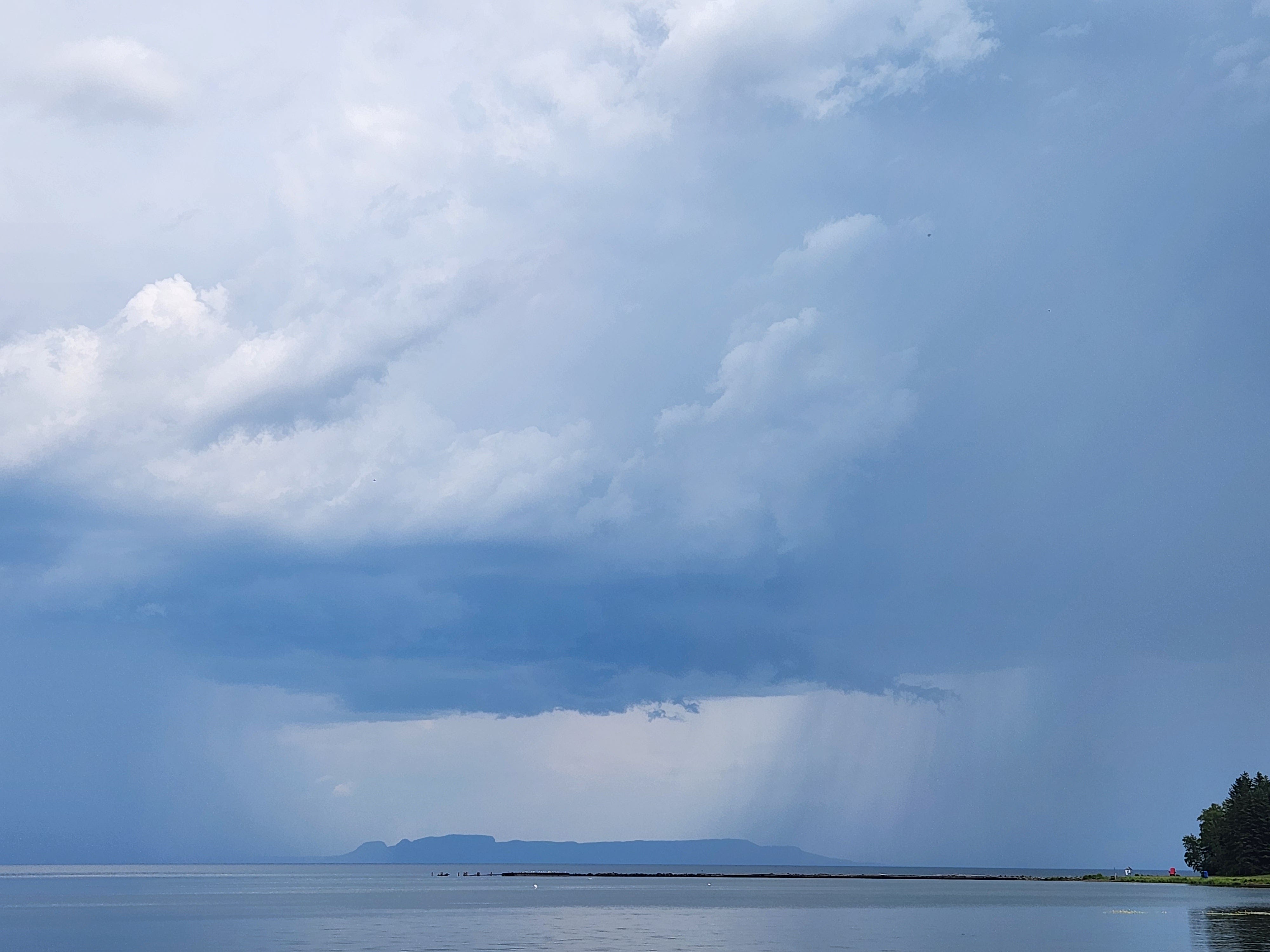
I grew up in Northwestern Ontario. I don’t speak for these communities. I am writing as a photographer, as someone who learned to see through images, and as someone who believes images carry responsibility.
Photography taught me something years ago: Every image is a decision.
AI is reminding us that every image is also an assumption.
What made this image believable?
I couldn’t stop thinking about this image.
Not just because it was inaccurate, but because it revealed something about the way we see.
A few questions stayed with me:
Why was this image even created?
Why did AI create it this way?
What made it feel true for some?
If you aren’t from the area or don’t take a moment to pause and think critically, would you believe it to be true?
What does that tell us about the stories we’ve already accepted about places we’ve never been?
I rarely go on Facebook anymore, but I went back recently because many of my old friends were sharing updates from the region.
A friend from my high school days, journalist Jon Thompson from Ricochet Media, shared the image. The original post came from Allan Okeese.
What stayed with me most was Allan’s post, the pain in his words, and the feeling of seeing your home represented by people or systems that do not know it.
And that matters.
Because for some people, this image was immediately unbelievable.
They knew. They recognized the place being shown wasn't their community.
For others, it passed the familiarity test.
And that is the uncomfortable question: Why?
The Frame We Inherited
AI didn’t decide what Northern Ontario looks like.
Long before generative AI existed, we built visual patterns about what places are supposed to look like.
Photography, advertising, news coverage, stock imagery.
Over time, certain images became the “default”.
A “community” looks a certain way.
A “remote place” looks a certain way.
A “Canadian town” looks a certain way.
AI doesn’t understand a place, its history, or its people. It predicts what a place is likely to look like based on the images it has already seen.
When those images reflect narrow perspectives, those assumptions get repeated.
AI doesn’t create bias out of nowhere. It can reproduce and amplify patterns already embedded in our visual culture.¹
Photographers have always made choices about what enters the frame and what stays outside it.
AI is simply forcing us to examine those choices at scale.
Representation isn’t only about accuracy; it’s about whose reality becomes the default.
Lens Shift: This Isn’t Really About AI
This isn’t really about AI. It’s about how easily we mistake familiarity for truth.
If we’ve spent decades seeing the same kinds of images, the familiar begins to feel accurate, even when it isn’t.
The question isn’t: “Is this image fake?”
The better question is: “What made it believable in the first place?”
Visual literacy isn’t only about identifying what is false.
It is about recognizing the assumptions shaping what feels true.
If we’ve mistaken familiar images for accurate ones, what else have we accepted without questioning?
That may be the greatest challenge of AI-generated imagery.
Not that it creates convincing fictions, it’s that it exposes the assumptions we’ve already accepted as reality.
The Pause
Before you scroll past the next image you see, ask yourself:
What story is this image asking me to believe?
What assumptions do I carry about places I’ve never been?
Whose stories do I know only through someone else’s lens?
Where have I mistaken representation for reality?
What feels “normal” simply because I’ve seen it more often?
And then, before you share an image, or better yet, before believing what you're seeing, please PAUSE.
Ask yourself:
Who created this?
Who benefits from this version of the story?
Who would recognize themselves here and who wouldn’t?
Who would look at this and say, “That’s not us.”
The most dangerous images aren’t always the ones that are obviously fake.
Sometimes they’re the ones that feel familiar enough that we stop asking questions.
Further Reading
Seeing is not neutral
A foundational exploration of how images shape meaning, perspective, and power. Berger’s work asks us to examine the relationship between what we see and what we know.
Who gets to define the frame?
Decolonizing Methodologies: Research and Indigenous Peoples, Linda Tuhiwai Smith
A foundational work examining how systems of knowledge, research, and representation have been shaped through colonial frameworks — and the importance of Indigenous approaches to knowledge creation.
Indigenous-led storytelling and visual sovereignty
Indigenous visual sovereignty asks a deeper question: Who has the relationship, responsibility, and authority to represent a community?
Explore work from Indigenous photographers, filmmakers, artists, and storytellers who are creating their own visual narratives rather than being represented through outside perspectives.
Notes
¹ Yang, Y. (2025). Racial bias in AI-generated images. AI & Society, 40, 5425–5437. https://doi.org/10.1007/s00146-025-02282-1